
A reflection on Matthew 9:18–26 (Trinity 24): the story of Jairus, the unnamed woman, and the one truth that holds them together — no one is an interruption to Jesus.
Fr. Dan's Trinity 24 sermon on Matthew 9:18–26 reflects on two people who interrupt each other's moments with Jesus. Jairus, a man of standing, falls to his knees begging Jesus to heal his dying daughter. Jesus immediately rises and follows him. On the way, a woman who has suffered a bleeding condition for twelve years quietly touches the hem of Jesus' garment, hoping to be healed unnoticed. Jesus stops, turns around, and calls her "Daughter" — restoring not only her body but her dignity and place in the community of God.
The apparent delay costs Jairus nothing: Jesus arrives and raises the girl from the dead. The sermon's central message is that no one is an interruption to Jesus. He stops for the overlooked, calls the forgotten by name, and takes even the dead by the hand. We are invited to receive this same unhurried, personal love at the altar rail — and to extend it to others when we are tempted to say, "Not now."
Trinity 24- Matthew 9:18-26
"While he spake these things unto them, behold, there came a certain ruler, and worshipped him, saying, My daughter is even now dead: but come and lay thy hand upon her, and she shall live. And Jesus arose, and followed him, and so did his disciples."
Here is a father in a hurry. Mark and Luke tell us his name was Jairus. He is a ruler, a man of standing, and he is on his knees in the road. A man like that does not kneel for small things. His little girl is dead, and he has one hope left. "Come and lay thy hand upon her, and she shall live."
Notice what Jesus does. He does not say, "Let me finish my teaching." He does not say, "Make an appointment." The Scripture says, "Jesus arose, and followed him." He gets up and goes. If ever there was a case for keeping your eyes on the road and not stopping for anything, this is it.
We all know that feeling. When something is truly urgent, everything else becomes an obstacle: the slow driver ahead, the long queue at the shop, the person who stops us in the aisle and says, "Have you got a minute?" When we are in a hurry, almost everyone looks like an interruption.
So Jesus sets off with Jairus, and the crowd presses in around them. Then something happens.
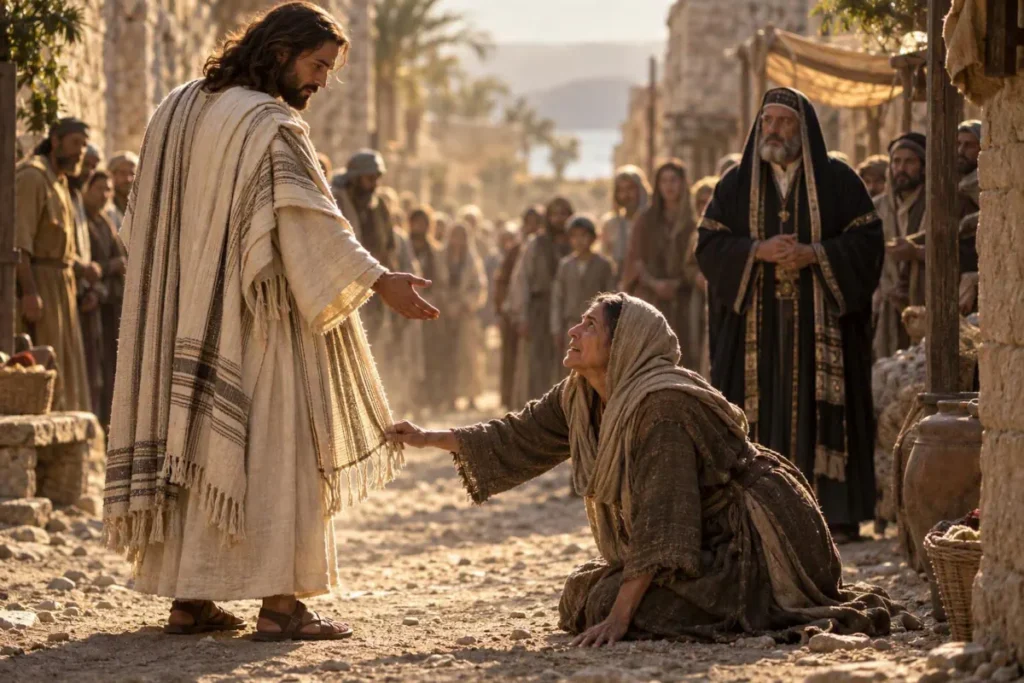
"And, behold, a woman, which was diseased with an issue of blood twelve years, came behind him, and touched the hem of his garment: for she said within herself, If I may but touch his garment, I shall be whole."
Look at how little she asks for. She does not come to the front, as Jairus did. She does not kneel and make her request out loud. She comes from behind. She has no name in this story. For twelve years she has been unclean under the law, which means she could not worship with the others, and anyone she touched would be unclean too. For twelve years people had been stepping carefully around her. She is used to being unnoticed, and she is hoping to go on being unnoticed, only this once with a miracle. Just the hem. Just the edge. Nobody needs to know.
And here is the awkward part for the rest of us. She is exactly the kind of person we would call an interruption. A father's child is dying, and now a stranger tugs at the coat. If Jesus had kept walking, nobody would have blamed him. Jairus certainly wouldn't have minded. The woman herself would have been quite content to slip away, healed and unseen.
But "Jesus turned him about, and when he saw her, he said, Daughter, be of good comfort; thy faith hath made thee whole. And the woman was made whole from that hour."
He turned about. Dear friends, hold on to those words. The most urgent errand in the world was waiting, and Jesus turned around. He looked for her, he saw her, and he called her "Daughter." Nobody in twelve years had called her anything like that. He did not only mend her body. He gave her back her place and her name in the family of God.
No one is an interruption to Jesus. We may think he is too busy with the big things, the great crises and the great sinners, to bother with our small ones. But he is never hurried the way we are. Nobody in need is in his way. The one we think of as a delay is the very person he turned around to find.
Now, if you were Jairus, you might be standing there wringing your hands. Every minute counts, and the Lord is having a conversation. We are not told what he thought. But we are told what happened next.
"And when Jesus came into the ruler's house, and saw the minstrels and the people making a noise, he said unto them, Give place: for the maid is not dead, but sleepeth. And they laughed him to scorn."
Notice the minstrels. The hired mourners had arrived before the doctor could, which tells you how quickly some people give up. They knew death when they saw it, and they laughed at the one man who knew better. It is hard to take the Lord seriously when you are sure you have seen everything.
"But when the people were put forth, he went in, and took her by the hand, and the maid arose."
He took her by the hand. The law said that touching the dead made a person unclean. Jesus is not afraid of that. Where he puts his hand, death has to give way. The woman touched the hem of his garment, and now he takes the dead girl by the hand. He is touched by the one who is unclean, and he touches the one who is dead, and neither makes him unclean. Instead they are made clean and alive.
And the delay? It cost nothing. Jairus feared the stop on the road would be the end of his hope. It was not. The Lord who has time for the woman in the crowd has all the time in the world for the child in the bed. He is never late because he is never rushed. He has no list of emergencies that crowds out the people he loves.
I think this is why we come to the altar rail the way we do. We come with our hands held out, not very sure of ourselves, a little like that woman reaching from behind. We come as people who have felt unnoticed, or too small, or too late. And the Lord who turned around for her comes to us in the bread and the cup, and he does not treat us as a delay. He takes us by the hand.
So let me say again the one thing to take home. No one is an interruption to Jesus. He stops for the unnoticed. He turns around and calls us daughter and son. And he takes us by the hand, even when we are as good as dead, and he raises us up.
Remember that this week when someone stops you at the wrong moment, and you are in a hurry and tempted to think, "Not now." It may be that the Lord has sent them. And remember it on the day you feel like the interruption yourself. You are not one to him. Amen.